
Goethe vs TELC vs TestDaF: Which German Language Certification Should You Choose?
June 9, 2026
German Language Learning for Working Adults in Kerala: How to Study Without Quitting Your Job
July 25, 2026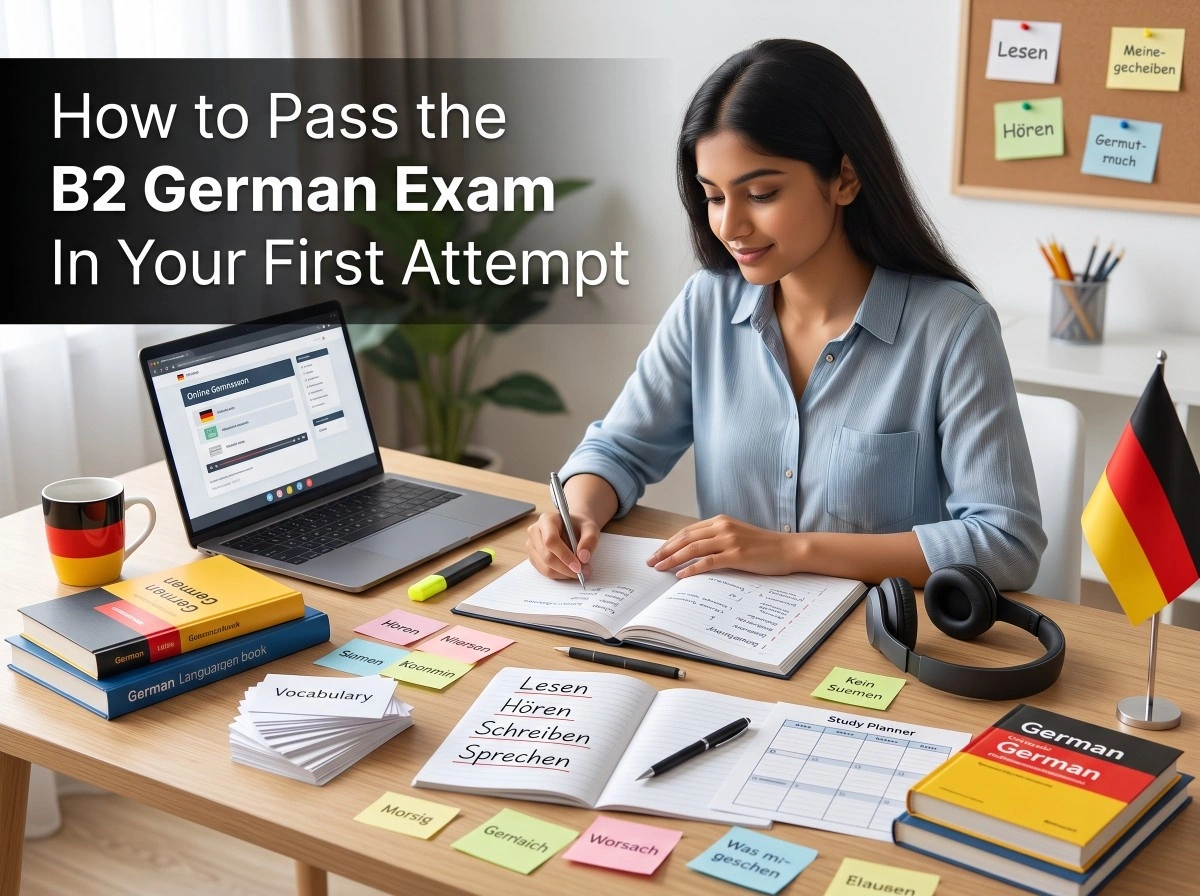
Pass with direction, not longer hours
At B2 level, you need more than basic communication. You should be able to understand detailed texts, follow natural conversations, write clearly, and express your opinion with confidence.
Many students fail not because they know nothing. They fail because they prepare in the wrong way.
They may revise grammar for weeks but avoid speaking. They may learn vocabulary but never practise writing under time limits. They may complete a course but never understand how the actual exam works.
So, how do you pass the German B2 exam in the first attempt?
You need three things:
- A steady daily study routine.
- Specific strategies for reading, writing, listening, and speaking.
- A calm mindset that helps you perform well on exam day.
Let us break it down clearly.
Is It Hard to Pass the B2 German Exam?
Yes, the B2 German exam can feel hard.
But it is not impossible.
The B2 level is difficult because you are no longer tested only on simple sentences or basic daily conversations. You are expected to:
- Understand longer German texts.
- Follow conversations, interviews, and opinions.
- Write structured answers.
- Speak about topics with reasons, examples, and opinions.
- Use formal and informal language correctly.
- Manage time during the exam.
This is where many students struggle. They know German, but they do not know how to use it inside an exam format.That is why B2 German exam preparation should not be random. You should understand the exam structure first, then prepare each module with a clear method.
Many students preparing for Ausbildung also need to clear the B2 German exam. If you are planning your Germany career pathway, choosing a German language institute that also supports Ausbildung guidance can simplify your preparation.
What Does the B2 German Exam Test?
Most B2 German exams test reading, listening, writing, and speaking.
Lesen: Reading
The reading module tests whether you can understand longer German texts.
You may get:
- Articles.
- Reports.
- Opinion-based texts.
- Notices.
- Informational passages.
- Gap-filling tasks.
The challenge is not just vocabulary. It is also time.
Many students spend too much time on one difficult question and lose marks in easier parts.
Hören: Listening
The listening module checks whether you can understand spoken German.
You may hear:
- Conversations.
- Interviews.
- Announcements.
- Discussions.
- News-style audio.
The difficult part?
The audio may feel fast. Some parts may also be played only once, depending on the exam format.
So, you should train yourself to listen for meaning, not every single word.
Schreiben: Writing
The writing module tests whether you can write clearly and logically.
You may need to write:
- A formal email.
- A complaint letter.
- A report.
- An opinion text.
- A forum-style response.
Here, structure matters a lot.
You should not simply write whatever comes to mind. Your answer should have a clear flow.
For example:
- Introduction.
- Main opinion.
- Reasons.
- Examples.
- Possible disadvantage.
- Conclusion or suggestion.
Sprechen: Speaking
The speaking module checks how well you can express yourself in German.
You may need to:
- Give a short presentation.
- Discuss with a partner.
- Respond to another person’s ideas.
- Ask questions.
- Share your opinion with reasons.
This is often the most stressful part for students.
But speaking becomes easier when you prepare useful phrases, practise with real topics, and learn how to continue even when you make a mistake.
How to Pass the German B2 Exam in First Attempt
To pass the German B2 exam in your first attempt, you need to prepare for the exam, not just the language. There is a difference. Learning German means improving your grammar, vocabulary, listening, and speaking, while preparing for the B2 exam means learning how to use those skills within a fixed time, in a fixed format, with clear scoring expectations.
Your preparation should include:
- Understanding the exam pattern.
- Practising all four modules.
- Building topic-wise vocabulary.
- Using Redemittel for writing and speaking.
- Taking timed mock tests.
- Getting feedback on writing and speaking.
- Training your mind to stay calm during the exam.
Do not wait until the last week to understand the exam structure.
Start with the format. Then build your practice around it.
Start with a Clear B2 German Exam Study Plan
A clear study plan prevents panic. You do not need to study all day, but you need consistency. A practical target is at least one hour of focused German practice every day, which helps you stay connected with the language and avoid forgetting what you have already learned. If your exam is near, you may need more than one hour, but even then, the focus should be planned practice, not random revision.
Daily B2 German Study Routine
Here is a simple daily routine you can follow:
- Spend 15 minutes revising vocabulary.
- Spend 15 minutes listening to German audio.
- Spend 20 minutes reading a B2-level text.
- Spend 20 to 30 minutes writing or speaking.
- Spend 10 minutes reviewing mistakes.
Adjust the plan: Give more time to weak skills; if writing is weak, practise one short task every alternate day.
Weekly Preparation Focus
A weekly plan can make your B2 German exam preparation more balanced.
You can divide your week like this:
- Practise reading and vocabulary on two days.
- Practise listening and note-taking on two days.
- Practise writing and speaking on two days.
- Use one day for mock test practice and correction.
Priority: Keep all modules active, but give your weakest one the most attention.
Build B2 German Vocabulary the Smart Way
At B2 level, simple vocabulary is not enough. You should know better words, topic-specific words, and useful expressions.
For example, instead of always using Problem, you can learn words like:
- die Schwierigkeit, difficulty.
- die Herausforderung, challenge.
- die Unannehmlichkeit, inconvenience.
- der Nachteil, disadvantage.
- die Auswirkung, effect or impact.
This does not mean you should use complicated words everywhere. Your goal is to sound clear, natural, and mature.
Learn Vocabulary by Topic
Learn words in context, grouped by common B2 topics:
- Education.
- Work and career.
- Health.
- Environment.
- Technology.
- Travel.
- Food and lifestyle.
- Media.
- Family and society.
- Migration and culture.
For each topic, learn:
- Nouns.
- Verbs.
- Adjectives.
- Connectors.
- Opinion phrases.
- Example sentences.
This will help you in reading, writing, listening, and speaking.
Use the 80/20 Rule in German Learning
Focus first on the areas that create the biggest exam improvement:
- Common exam topics.
- Frequently used connectors.
- Formal email phrases.
- Opinion phrases.
- Speaking presentation phrases.
- Listening keywords.
- Grammar structures that appear often.
Rule: Prioritise language you will actually use before learning rare words.
Skill-by-Skill B2 German Practice
Use these focused tabs to improve reading, writing, listening, and speaking without scrolling through four long separate sections.
Improve Reading for B2 German Exam
Reading is not about translating every word. If you try to translate the full text, you will lose time. The better method is to read with purpose.
Before reading the passage fully, look at the questions. This helps you understand what information you need to find. Then read the text with focus.
Use Skim and Scan Techniques
For B2 German reading practice, use two methods:
- Skimming means reading quickly to understand the main idea.
- Scanning means searching for specific details.
For example, if the question asks about a person’s opinion, look for opinion markers like:
- meiner Meinung nach.
- ich finde.
- meiner Ansicht nach.
- ich bin überzeugt, dass.
- jedoch.
- trotzdem.
- allerdings.
These words help you understand the direction of the text.
Pay Attention to Connectors
Connectors are very important in the reading module.
They show how ideas are connected.
For example:
- weil shows reason.
- deshalb shows result.
- obwohl shows contrast.
- trotzdem shows contradiction.
- außerdem adds information.
- zum Beispiel gives an example.
If you understand connectors, you can understand the logic of the text better.
This is especially helpful in gap-filling and sentence matching tasks.
Improve Writing for B2 German Exam
Writing at B2 level should be clear, structured, and relevant to the task.
You do not need to write like a German novelist.
You need to answer the question properly.
A good B2 writing answer should have:
- Clear paragraphs.
- Correct tone.
- Relevant points.
- Good connectors.
- Examples.
- A proper ending.
Use Redemittel for B2 German Writing
Use ready-made phrases to structure answers quickly:
- Meiner Meinung nach...
- Ich bin der Ansicht, dass...
- Ein wichtiger Vorteil ist...
- Auf der anderen Seite...
- Ein Beispiel dafür ist...
- Zusammenfassend kann man sagen, dass...
Tip: Memorise sentence patterns—not full essays—and adapt them to the topic.
Follow the Right Structure for Opinion Writing
Use a clear six-step flow:
- Introduce the topic.
- Give your opinion.
- Explain one or two reasons.
- Add an example.
- Mention an opposite view.
- Finish with a short conclusion.
Example: For online learning, explain its flexibility, note reduced classroom interaction, and suggest a balanced mix.
Use Formal Language When Needed
Match your tone to the recipient. For schools, companies, managers, or officials, use formal German:
- Sie
- Ihnen
- Sehr geehrte Damen und Herren
- Sehr geehrter Herr...
- Sehr geehrte Frau...
- Mit freundlichen Grüßen
Avoid informal language in formal emails; this simple mistake can cost marks.
Add Solutions When Writing Complaints
Do more than state the problem—suggest a constructive solution:
- Check quality regularly.
- Introduce a feedback system.
- Review the service.
- Correct the issue before the next event.
This demonstrates stronger language control and communication.
Improve Listening for B2 German Exam
Listening becomes easier when you stop trying to understand every word.
In the exam, your goal is to catch the meaning.
You should listen for:
- Keywords.
- Speaker opinion.
- Main idea.
- Time references.
- Numbers.
- Contrast words.
- Agreement or disagreement.
Before the audio starts, read the questions carefully.
This gives your brain a direction.
Read the Questions Before the Audio
Use the short preparation time wisely.
Look at:
- What the question is asking.
- The answer options.
- Names, numbers, places, or dates.
- Keywords you may hear in the audio.
This helps you listen actively.
For example, if the question asks why a person changed jobs, listen for words related to salary, stress, career growth, distance, or work environment.
Do Not Panic If You Miss One Word
This is very important. Many students lose focus because they miss one word, but one missed word does not mean the whole answer is gone. Keep listening, because the next sentence may give you the answer. Train yourself to stay calm and continue.
Improve Speaking for B2 German Exam
Speaking is where confidence matters.
But confidence does not come from waiting.
It comes from practice.
At B2 level, you should be able to speak about a topic, give reasons, respond to another person, and continue even if you make small mistakes.
You are not expected to speak perfect German.
You are expected to communicate clearly.
Use Keywords, Not Full Sentences During Preparation
In the speaking exam, you may get preparation time. Use it carefully: write only keywords, and do not write full sentences and read them aloud.
Reading makes your speaking sound unnatural. It can also affect your score because the examiner wants to see your ability to speak, not read.
For example, if the topic is healthy eating, your notes can look like this:
- wichtig für Gesundheit.
- weniger Fast Food.
- mehr Obst und Gemüse.
- Beispiel: Schule, Kantine.
- Nachteil: teurer.
- Lösung: bessere Planung.
These keywords are enough to help you speak naturally.
Prepare Redemittel for Speaking
Useful speaking phrases can help you stay calm, and you can prepare phrases for different parts of the speaking test.
To start:
- Ich möchte heute über das Thema ... sprechen.
- In meiner Präsentation geht es um ...
To give your opinion:
- Meiner Meinung nach...
- Ich bin der Ansicht, dass...
To give examples:
- Ein gutes Beispiel dafür ist...
- Aus meiner eigenen Erfahrung kann ich sagen, dass...
To show contrast:
- Auf der einen Seite... auf der anderen Seite...
- Allerdings sollte man auch beachten, dass...
To conclude:
- Zusammenfassend möchte ich sagen, dass...
- Damit bin ich am Ende meiner Präsentation. Vielen Dank.
These phrases do not replace real speaking practice; they simply help you stay organised.
Speak With Your Partner, Not Against Them
In the discussion part, do not treat your partner like an opponent. The speaking test is not a debate competition; it is a communication task. If your partner is quiet, encourage them.
You can say:
- Was denken Sie darüber?
- Sind Sie damit einverstanden?
- Haben Sie vielleicht ein anderes Beispiel?
If you do not know what to say, you can paraphrase your partner’s point.
For example:
- Wenn ich Sie richtig verstanden habe, meinen Sie, dass...
This keeps the conversation moving.
You Can Invent Examples
In the speaking exam, you are graded on language, not your personal life story.
So, if you do not have a real example, create a simple one.
For example, if the topic is public transport and you do not travel by bus often, you can still say:
- In my city, many students use public transport because it is cheaper.
- One of my friends travels by train every day.
- In my opinion, better public transport can reduce traffic.
The examiner is checking your German, not verifying your personal experience.
Self-Study, Timelines & Registration Clarity
Each topic is now shown as a full-width container for easier reading and cleaner spacing.
Can I Self Study B2 German?
Yes, you can self-study B2 German.
But it depends on your current level, discipline, and ability to correct your own mistakes.
Self-study may work if:
- You already have a strong B1 foundation.
- You practise every day.
- You use proper B2-level materials.
- You take mock tests.
- You can get writing corrections from someone.
- You regularly practise speaking.
The difficult part of self-study is feedback.
You may not notice repeated mistakes in writing. You may also think your speaking is clear when it needs improvement.
That is why many students choose guided German B2 exam preparation, especially when the exam is connected to study, work, or Ausbildung plans.
Can I Learn B2 German in 3 Months?
This depends on where you are starting from.
If you are already strong in B1, three months may be enough to prepare for the B2 exam format with focused practice.
But if you are starting from A1 or A2, becoming exam-ready for B2 in three months is usually not realistic for most learners.
Your timeline depends on:
- Your current German level.
- Your vocabulary strength.
- Your grammar accuracy.
- Your daily practice time.
- Your listening exposure.
- Your speaking confidence.
- Your mock test performance.
Do not rush to book the exam only because you completed a course.
Book the exam when your mock test performance shows that you are ready.
Why Proper B2 German Exam Preparation Matters
B2 is an important level for many students.
It may be needed for study, work, Ausbildung, visa-related steps, or career plans in Germany.
A failed attempt can affect:
- Time.
- Confidence.
- Exam fees.
- Application plans.
- Career timelines.
That is why proper preparation matters.
A good B2 German preparation plan should help you:
- Understand the exam format.
- Build topic-wise vocabulary.
- Practise reading with time limits.
- Improve listening with active focus.
- Write structured answers.
- Speak with confidence.
- Take mock tests before the actual exam.
If you are preparing from Kerala and want classroom-based guidance, Vidacta offers offline German language training with structured preparation from A1 to B2. Students can also get exam-focused support and guidance for their German language learning path.
Unsure if you are exam-ready?
Use mock tests and expert feedback to turn uncertainty into a clear plan.
Mock Tests, Booking Checks & Final Checklist
Use these three practical blocks before you register for the B2 German exam.
Use Mock Tests Before B2 German Exam Registration
Mock tests are one of the most important parts of B2 German exam preparation. They show you where you really stand. You may feel confident while studying, but the real question is:
Can you perform under time pressure?
A mock test helps you check:
- Whether you can finish reading on time.
- Whether you can understand listening audio under exam conditions.
- Whether your writing is clear and complete.
- Whether you can speak without memorising full answers.
- Whether you can stay calm when a question feels difficult.
Take mock tests seriously. Do not just check your score. Review every mistake.
What to Check Before Booking the B2 German Exam
Before your B2 German exam registration, ask yourself:
- Can I complete the reading section within time?
- Can I write a formal email with the correct tone?
- Can I write an opinion text with structure?
- Can I understand the main idea in German audio?
- Can I speak for a few minutes on common topics?
- Can I respond to a partner in German?
- Have I received feedback on my writing and speaking?
- Are my mock test scores consistent?
If the answer is mostly yes, you are closer to being exam-ready. If not, spend more time on your weak areas.
Final B2 German Exam Preparation Checklist
Before the exam, make sure you have covered these points:
- ✓You understand the structure of your B2 German exam.
- ✓You have practised reading with time limits.
- ✓You have written formal emails and opinion texts.
- ✓You know useful Redemittel for writing and speaking.
- ✓You have practised listening without pausing the audio.
- ✓You can speak on common B2 topics for a few minutes.
- ✓You have taken mock tests.
- ✓You have reviewed your mistakes.
- ✓You have received feedback on writing and speaking.
- ✓You know how to stay calm if one module feels difficult.
Passing B2 German in the first attempt is possible. But you need to prepare with a plan. Do not study only what feels easy. Work on the sections that make you uncomfortable. That is where your real improvement will happen.
FAQs on B2 German Exam Preparation
Is it hard to pass the B2 German exam?+
Yes, the B2 German exam can be hard because it tests advanced communication skills. You need to understand longer texts, write structured answers, follow natural German audio, and speak with confidence. But with regular practice and exam-focused preparation, it is possible to pass in the first attempt.
How to pass the German B2 exam?+
To pass the German B2 exam, understand the exam structure first. Then practise reading, writing, listening, and speaking separately. Build topic-wise vocabulary, use Redemittel, take timed mock tests, and get feedback on writing and speaking before the exam.
Is German B2 tough?+
German B2 is tougher than B1 because you need to express opinions, understand complex topics, and use the language more independently. It becomes easier when you follow a structured study plan and practise under exam conditions.
Can I self study B2 German?+
Yes, you can self-study B2 German if you are disciplined and already have a strong foundation. But writing and speaking are harder to improve without correction. If you keep repeating the same mistakes, guided preparation may help.
Can I learn B2 German in 3 months?+
If you are already strong in B1, three months may be enough to prepare for the B2 exam format. But if you are starting from A1 or A2, reaching exam-ready B2 in three months is usually difficult for most learners.
What is the 80/20 rule in German?+
The 80/20 rule means focusing on the most useful parts of German that bring the biggest improvement. For B2 exam preparation, this includes common topics, connectors, formal phrases, opinion structures, listening keywords, and mock test practice.
Prepare for Your B2 German Exam with Better Clarity
If you are preparing for the B2 German exam, do not leave your result to guesswork.
A structured plan, regular practice, and proper feedback can make your preparation stronger.
Vidacta offers offline German language training in Kerala with focused preparation from A1 to B2. This may be a good option if you want classroom-based learning, speaking practice, writing support, and exam-focused guidance before your B2 German exam.